
Description
Description:
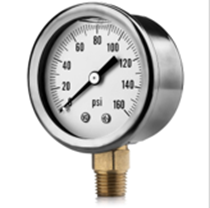
A pressure gauge is an instrument designed to measure and display the force exerted by liquids or gases within a pressurized system. They are critical for monitoring operations, ensuring safety, and preventing system failures by providing, in real-time, analog or digital readings of hydraulic, pneumatic, and steam pressures.
Pressure Gauges:
Types: The most common type is the Bourdon-tube gauge, which uses a, flat, circular tube that straightens under pressure to move a pointer. Other types include metal bellows and diaphragms, often used for low-pressure applications.Function: They measure absolute, gauge, or differential pressure.
Applications: Essential in industrial processing, manufacturing, automotive, and HVAC systems for troubleshooting and maintaining efficiency.Units: Common measurement units include pounds per square inch (PSI), bar, and pascals (Pa).
Safety: Without accurate pressure readings, systems can become hazardous.
Maintenance: They allow technicians to detect leaks and undesired pressure changes immediately.
Quality Control: Crucial for industrial processes that depend on precise, consistent pressure
Recent Comments